Fake revenue screenshots, outdated royalty math, and the “upload 50 books in a weekend” grift. Let’s check the receipts.
Transparency note: The firsthand observations, creative workflow notes, and opinions here are mine; links identify the external sources supporting factual claims. As an Amazon Associate, I earn from qualifying purchases at no extra cost to you.
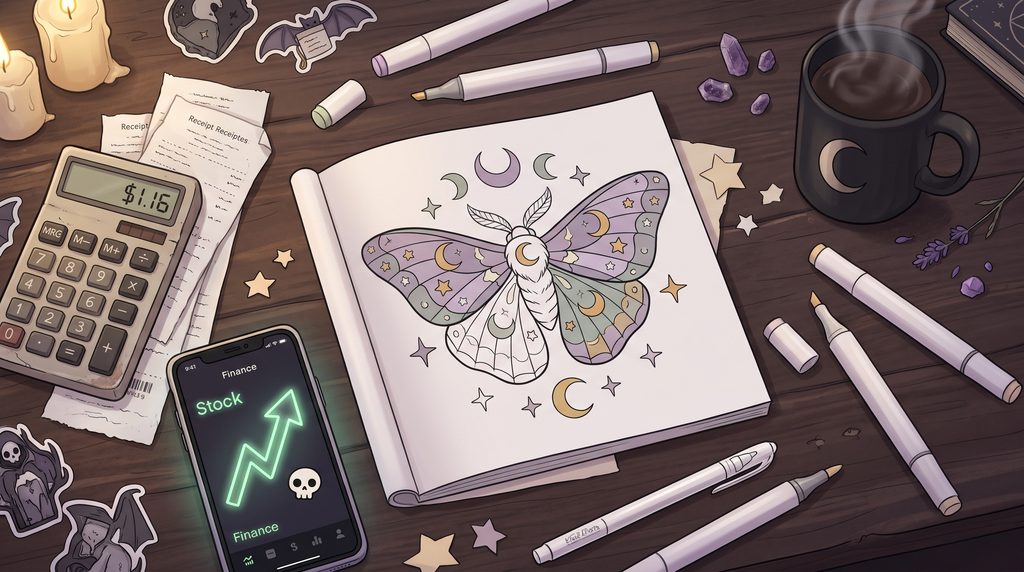
If you spend more than five minutes researching coloring books, indie publishing, or creative side hustles on TikTok or YouTube, the algorithm will eventually serve you The Coloring Book Bro.
You know the script: a guy with a studio mic and a green-screen screenshot of an Amazon bestseller page tells you that coloring books are a "goldmine." According to him, you don't need to know how to draw, you don't need to care about coloring, and you definitely don't need to spend more than 15 minutes per book. Just ask an AI generator for 40 pictures of "cute frogs," slap them into a free Canva template, upload 20 books a week to Amazon Kindle Direct Publishing (KDP), and watch $10,000 a month in "passive income" roll in while you sleep.
Oh, and if you want his exact copy-and-paste prompts? Just buy his $297 course or use his affiliate link for a $49/month "one-click book generator."
As someone who actually lives in the world of cozy coloring books and KDP, let’s pull back the curtain on this entire grift; starting with the math that these videos conveniently leave out.
Receipt #1: The Real KDP Royalty Math (And the $9.99 Cliff They Ignore)
In almost every "make $10k/month with coloring books" video, the hustle guru pulls up a notepad and writes something like this:
- "Sell your book for $7.99, make $4.00 profit per book, sell 80 books a day, boom—$10,000 a month!"
There is just one problem: that math is completely fictional.
First, standard adult and cozy coloring books are almost always printed at 8.5" × 8.5" or 8.5" × 11". In Amazon KDP’s printing cost structure, any book wider than 6.12 inches or taller than 9 inches is classified as a Large Trim Size. For a black-and-white paperback between 24 and 108 pages (which covers virtually every 30- to 50-page single-sided coloring book), Amazon charges a flat $2.84 per book in printing costs on the US marketplace.
Second; *and this is the part that immediately exposes creators using recycled scripts* Amazon changed its paperback royalty rate structure in June 2025. Any paperback priced at $9.98 or below on Amazon.com now earns a 50% royalty rate, not 60%. You only unlock the 60% royalty tier when you price your book at $9.99 or higher.
When you apply the actual formula (List Price × Royalty Rate) − $2.84 Print Cost, the numbers look very different:
| List Price | KDP Royalty Tier | Gross Share | Large-Trim Print Cost (24–108 Pages) | Your Actual Royalty Per Book | Sales Needed Per Month for $10,000 |
| $6.99 | 50% | $3.50 | −$2.84 | $0.66 | 15,152 copies (~505/day) |
| $7.99 | 50% | $4.00 | −$2.84 | $1.16 | 8,621 copies (~287/day) |
| $8.99 | 50% | $4.50 | −$2.84 | $1.66 | 6,024 copies (~201/day) |
| $9.98 | 50% | $4.99 | −$2.84 | $2.15 | 4,651 copies (~155/day) |
| $9.99 | 60% | $5.99 | −$2.84 | $3.15 | 3,175 copies (~106/day) |
Take a hard look at that $7.99 row, because $7.99 to $8.99 is where most impulse-buy coloring books compete on Amazon. At $7.99, you make $1.16 per book. Even if you price at $9.99 to clear the 60% royalty cliff, you earn $3.15 per copy, meaning you need to move more than 100 copies every single day just to gross $10,000 a month.
And that’s assuming you spend zero dollars getting people to find your book. Which brings us to Receipt #2.
Receipt #2: The Amazon Ads Tax (Why "Upload and Pray" Fails)
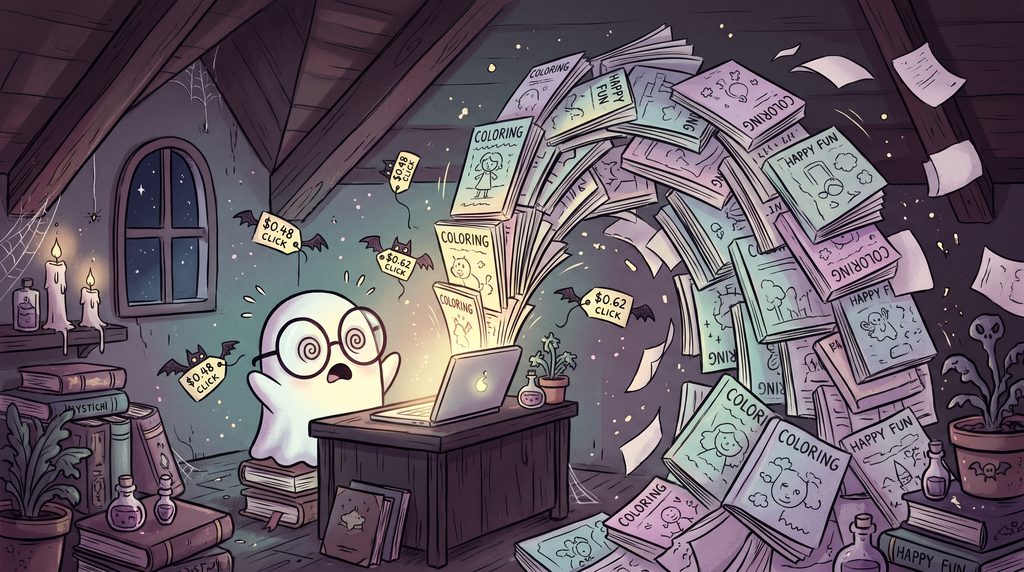
The core promise of the "passive income" pitch is that Amazon is a magical search engine where millions of shoppers are just waiting to stumble across your newly uploaded book.
In reality, when you hit publish on a brand-new KDP book with zero sales history and zero reviews, it lands somewhere around page 40 of the search results, buried beneath tens of thousands of established titles.
To get eyes on a new book, you only have two options:
- Build an off-Amazon audience (through a blog, Pinterest, Instagram, TikTok, or an email list, which is rewarding work, but the exact opposite of "15-minute passive income").
- Pay for Amazon Advertising (Sponsored Products), which runs on a cost-per-click (CPC) auction system.
In the coloring book category, average cost-per-click bids typically range from $0.35 to $0.65+ per click (and climb even higher during the Q4 holiday gift rush). You pay for every click whether the shopper buys your book or not.
Let’s run the ad math on a brand-new book with no reviews:
- Suppose you pay an average of $0.45 per click.
- Suppose 1 out of every 10 people who click your ad actually buys the book (a 10% conversion rate, which is generous for a brand-new listing with zero social proof).
- That means it costs you 10 clicks × $0.45 = $4.50 in ad spend to generate one single sale.
If your book is priced at $7.99 ($1.16 royalty), you just lost $3.34 on that sale. Even if your book is priced at $9.99 ($3.15 royalty), you still lost $1.35.
Established indie publishers use ads strategically to build momentum, earn organic rank, or bring readers into a larger brand catalog. Hustle-bro spam accounts don't survive the ad auction because a shopper who clicks an ad still checks the interior preview and reviews before buying—and low-effort slop doesn't convert.
Receipt #3: Why "15-Minute AI Slop" Gets Rejected by Both Amazon and Actual Colorists
Even if someone ignores the math and tries the "quantity over quality" strategy, uploading dozens of hastily generated books hoping a few randomly stick, they hit two brick walls immediately: Amazon’s enforcement algorithms and real human colorists.
1. Amazon’s 3-Book Daily Limit and AI Disclosure Rules
Because mass-upload spammers flooded the marketplace in 2023 (with many thanks to Coloring Book Bro), Amazon instituted a strict three-title-per-day publishing cap across KDP accounts, backed by automated velocity checks that flag accounts churning out repetitive low-effort titles. On top of that, KDP’s Content Guidelines require publishers to explicitly disclose AI-generated text or images during setup. Accounts that try to game velocity limits, stuff trademarked keywords into subtitles, or hide mass-generated content regularly face account termination, with pending royalties frozen.
2. Colorists Spend an Hour Staring at Every Page
A hustle bro scrolling through 40 generated images in 90 seconds thinks, "Looks like a cute cat in a bakery, ship it!"
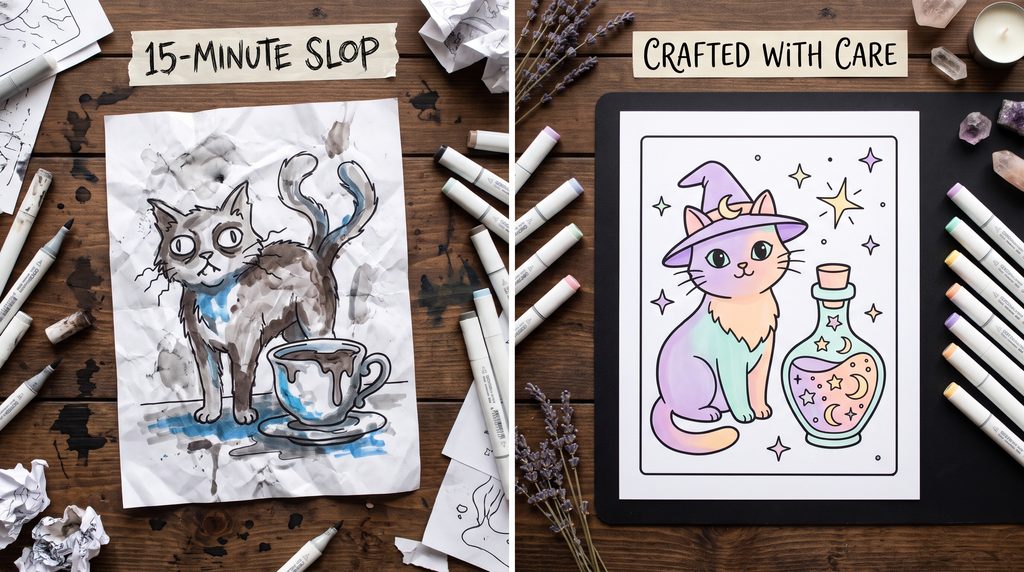
Someone who actually sits down to color that page with a set of alcohol markers spends 45 to 90 minutes examining every single millimeter of the linework. When you rush out raw, unedited AI coloring pages in 15 minutes, colorists immediately spot the disasters:
- Accidental Grayscale & Muddy Shading: Raw image generators love adding soft gray shading, crosshatching, and heavy black blotches to fake depth. On a screen, it looks fine. On paper, trying to color over muddy gray toner with a pastel marker creates a streaky, muddy mess.
- The Anatomy & Geometry Horrors: Teacup handles attached to nothing, cats with two tails, bookshelves that melt into window frames, and flower petals that vanish mid-line. Nothing kills a relaxing coloring session faster than realizing you're coloring a mystery blob that belongs to neither the frog nor the mushroom it's sitting on.
- Wildly Inconsistent Line Weights: Page 1 has thick, bold marker lines; Page 2 has microscopic, spidery etching lines you couldn't color with a needle; Page 3 has sketchy broken outlines where colors bleed into neighboring spaces.
- Double-Sided Printing Disasters: Standard KDP white paper is approximately 50–60 lb (74–90 gsm) uncoated trade paper—not heavyweight marker cardstock. Creators who don't actually color print illustrations on both sides of the page to save on page count, guaranteeing that the first alcohol marker stroke bleeds straight through and ruins the illustration on the back.
- Take 15 minutes to go through any coloring subreddit. Colorists are so against AI and fear supporting it so much now, the paranoia has caused every coloring book author to be questioned for the tiniest flaw. It's quite annoying to the point I'd love to upload some images from old coloring books before AI and watch the fingers point the AI accusation.
What Actually Goes Into Making a Good Coloring Book
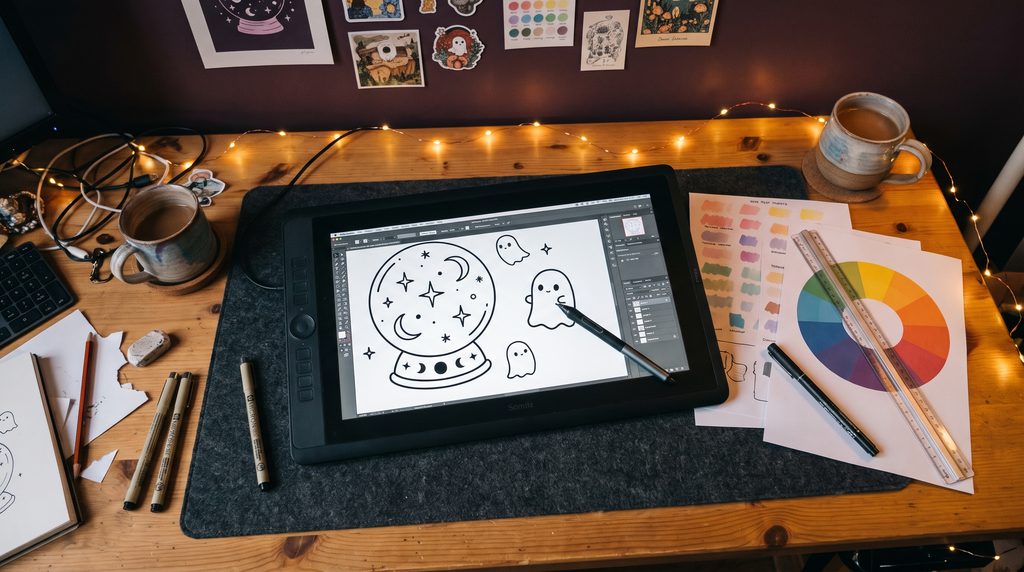
Whether an indie creator draws every line from scratch in Procreate, uses vector tools in Adobe Illustrator, or uses AI as part of an assisted concept workflow, creating a coloring book worth buying takes dozens of hours of intentional design and quality control.
Here is what the "15-minute" crowd skips that real creators actually do:
- Cohesive Worldbuilding & Character Continuity: Planning a real book brief where characters, proportions, and cozy environmental details stay consistent from page 1 to page 40.
- Line-Weight Standardization & Vector Cleanup: Stripping out every trace of accidental grayscale, closing broken line gaps, fixing awkward tangents, and ensuring uniform, smooth black outlines (pure
#000000line art on a pure#FFFFFFbackground) so markers have clean boundaries. - Colorability Checks: Asking on every single object: "Can someone actually fit a brush-tip marker or colored pencil in this space? Is it clear which shape is the foreground and which is the background?"
- Single-Sided Formatting & Margin Engineering: Leaving proper outer margins so designs don't get swallowed by the book spine, formatting every illustration single-sided so ink bleed doesn't destroy the next piece, and including color test swatch sheets at the back.
- Physical Test Printing: Printing pages out on standard uncoated copy paper at home and coloring them with real markers and pencils before a customer ever spends a dime.
The Verdict
Can you make real money creating and publishing coloring books? Yes, if you treat it like a real creative business and an actual craft.
Publishers who succeed on KDP (and Etsy, and their own shops) aren't uploading 50 unedited books a week. They are building recognizable artistic styles, obsessing over line quality, testing their pages with real markers, pricing intelligently around KDP's $9.99 royalty threshold, and building genuine communities of people who love to color.
Whenever someone promises you that you can skip the craft, skip the math, and skip caring about the customer to make $10,000 a month in 15 minutes, remember: you aren't their student. You're their revenue stream.
I use AI to assist in things I cannot do, I publish on KDP, I do not make over $100 a month, I am making mistakes and learning, I am sharing this real unedited knowledge with you on my journey. And once again, another information filled post with no affiliate links or pressure to buy something. It can be done.