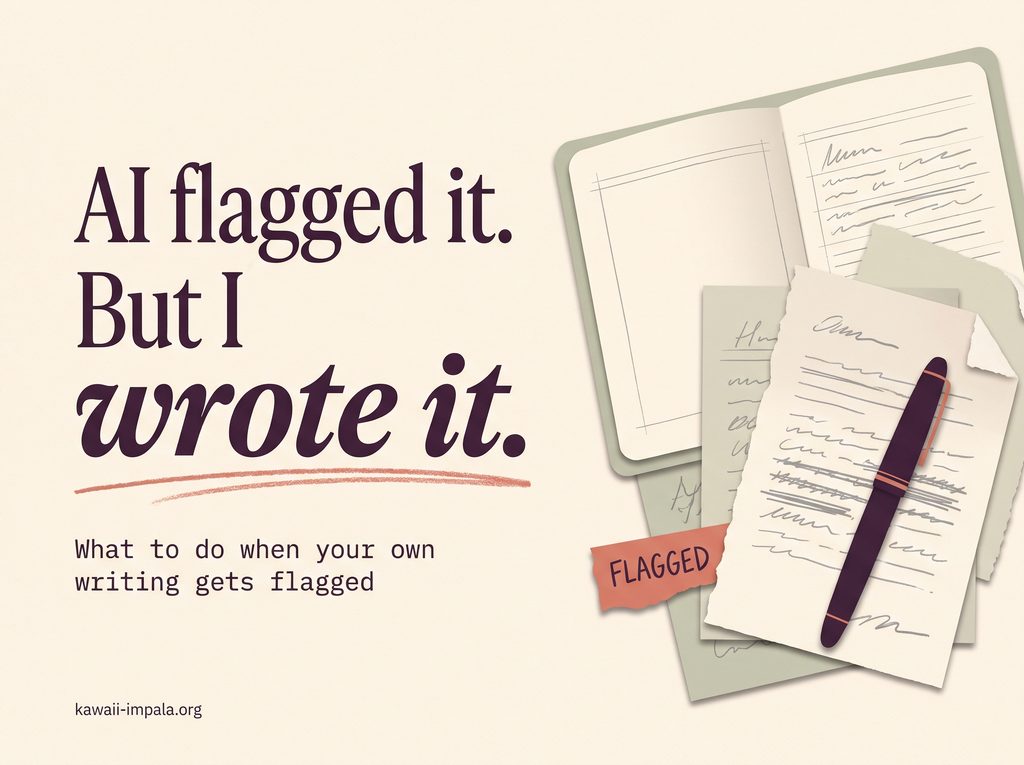
I’ve had writing I created myself flagged by an AI scanner, and it happens to me a lot.
There is something especially frustrating about being asked to question your own work when you know where the words came from. You wrote them. Yet a percentage on a screen can suddenly make it feel as though you have something to defend.
If this has happened to you, you deserve a response that takes your work seriously. There are practical steps you can take without turning every writing session into an attempt to please a detector. And if its happened more than once, it will continue to happen because the choice of words and phrases you use match typically produced AI content.
Start by saving your original draft and the report. Then gather whatever records you have of your writing process and, if someone is questioning your work, ask for a human review.
Can an AI detector flag human writing?
Yes. That mistake is called a false positive: a detector identifies human-written text as likely AI-generated.
Turnitin’s own guidance acknowledges that its model can misidentify writing. It advises educators against taking adverse action against a student based only on the detector’s result.
There is also published research documenting problems. A 2023 study by Liang and colleagues found that the detectors they tested frequently misclassified writing by non-native English writers. That finding applies to those tools and samples at that time; it does not give us a universal error rate for every detector available today.
The important point is that a confident-looking result can still be wrong.
Without seeing the particular tool, report, and text, we cannot know why your writing was flagged. A list of supposedly suspicious words or punctuation marks cannot establish who wrote a piece.
AI detectors are a whole new realm compared to plagarisim detectors which are based on copying something word for word. With billions of generations everyday, it is near impossible to prove writing was in fact generated with a generator.
Understand what the percentage actually means
An “80% AI” result can look like an 80% probability that you used AI. That interpretation may be incorrect.
For example, Turnitin describes its percentage as the share of qualifying prose its model identifies as likely AI-generated or AI-generated and subsequently modified. It is not a direct probability that the writer cheated. Other tools may define their scores differently, so read the explanation for the specific report.
Turnitin also distinguishes its AI score from its similarity score. An AI flag is not, by itself, evidence that you copied another person’s work.
Before responding to a number, find out what it measures.
1. Save your work before changing anything
Keep a copy of the exact version that received the flag. Save the report or take a screenshot showing the tool, result, and date.
If somebody else ran the scan, ask for the full report, including the highlighted passages. A message saying “this looks AI-written” gives you very little to respond to.
Make any later edits in a separate version. Keeping the original lets you discuss the actual text that raised the concern.
You do not need to immediately rewrite a piece you were happy with.
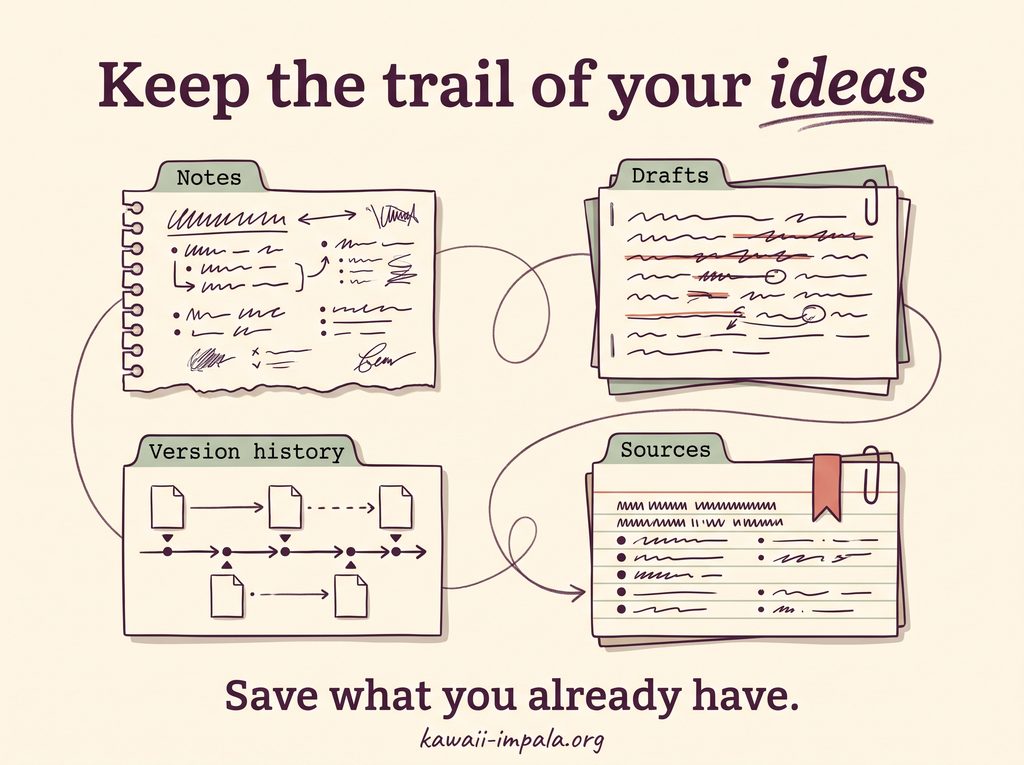
2. Gather the records you already have
Useful supporting material might include:
- Your outline, brainstorming notes, or handwritten pages.
- Earlier drafts and saved revisions.
- Document version history, if available.
- Research notes and sources you consulted.
- Relevant messages discussing the piece while you worked on it.
These records can help show how the writing developed. None is an automatic guarantee that a reviewer will accept your explanation, but they offer context that a score alone cannot provide.
If you wrote everything in one sitting and have few records, that does not establish AI use. Gather what exists and explain your process honestly. Do not manufacture an earlier draft or pretend that newly created notes are old ones.
I use AI to help with grammar, something I still struggle with. If you utilize a process such as that, make sure to keep a before and after copy.
3. Ask for a human review
If a teacher, editor, client, or employer is questioning your writing, bring the discussion back to the work and how you produced it.
Ask which passages caused concern, what policy applies, and what other evidence is being considered. Offer to explain your research, structure, and revisions.
Here is a message you can adapt:
Hello [Name],
I wrote the piece myself and would like to request a human review of the AI-detector result. Could you share the full report, the specific passages that raised concern, and the policy being applied?
I can explain how I developed the piece and share the supporting materials I have. Please consider that information alongside the detector’s limitations before reaching a decision.
Thank you for reviewing this with me.
Use that wording only when it accurately describes your process. If you used AI assistance, explain what it did rather than making a broader claim that no AI was involved.
For a formal school or workplace dispute, check the review process and any deadlines. Keep copies of the correspondence.
4. Be specific about any tools you used
“Using AI” can mean several different things: generating paragraphs, brainstorming an outline, translating text, or accepting rewritten sentences from an editing assistant.
Describe what you actually did. Saying “I used an editing tool” may leave important details unclear.
For example, if true, you might explain that you wrote the draft yourself and used a tool to flag spelling mistakes, without accepting generated passages. If a tool rewrote sentences, say that instead.
Whether a particular use is allowed depends on the rules for that assignment, publication, or client. A detector score cannot settle that policy question.
5. Avoid getting trapped in the rescan cycle
It is tempting to keep changing sentences until the scanner gives you a result you like. But a different score does not establish authorship any more than the original score did.
Adding deliberate mistakes, forcing slang into a formal article, or using an “AI humanizer” can leave you with writing you like less. None offers a dependable guarantee of acceptance.
Edit for things you can actually evaluate: accuracy, clarity, useful examples, good organization, and whether the piece says what you mean.
Before uploading unpublished or confidential writing to additional services, check how they handle submitted text. You do not need to scatter your work across unfamiliar websites to collect competing scores.
6. If you are checking your own blog, return to your readers
Sometimes nobody has accused you of anything. You ran your own writing through a checker, and now the result is making you doubt it.
In that situation, pause before letting the score become your editor.
Read the post aloud. Check the facts. Replace vague advice with something useful. Add a personal example when you have a real one that helps the reader.
You do not have to invent a story, share private details, or make your writing deliberately ignorant to demonstrate that a person is behind it.
Ask whether the post is honest, clear, and helpful. Those are better editorial questions than whether every sentence can satisfy a scanner.
Make your process easier to document next time
A simple habit is enough to start: keep your outline, save a first draft, and retain a revised version. Use version history where your writing app supports it, and keep your research links nearby.
This is a practical record of your work, not a promise that you will never be questioned again.
You should be able to concentrate on writing. If a detector flags something you wrote, preserve the work, explain the process, and ask for the evidence to be considered fairly.
Have you ever had your own writing flagged as AI-generated? What happened, and how did you respond?